

How Does a Mountaineer’s Day Start

Have you ever wondered how does a mountaineer’s day start? I will give you a hint: you wake up at 3 am, set the stove, wake up your partner, pretend it is warm, quickly consume a high-calorie breakfast, watch your friends slowly ascending the icy slopes of your dream summit with their tiny head torches glimmering against perfectly blue ice, and hope for the good weather. One would ask: why all this trouble? The answer is easy: for the love of the adventure and the unknown.
Photo and caption by Kamil Tamiola
Location: Chamonix, Haute Savoye, France
Source: National Geographic Traveler
Lost in the Wilderness of Yosemite
Here’s outstanding picture from the 2012 Astronomy Photographer of the Year competition.
The photographer Steven Christenson came across two hikers lost in the wilderness of Yosemite one evening in July 2011. He captured this image of the tiny figures in a small bubble of torchlight

Image: Lost in Yosemite by Steven Christenson (USA)
Dancing House in Prague
The Dancing House or “Fred and Ginger” is the nickname given to the Nationale-Nederlanden building in Prague, Czech Republic. It was designed by the Croatian-Czech architect Vlado Milunic in cooperation with the renowned Canadian-American architect Frank Gehry on a vacant riverfront plot. The building was designed in 1992 and completed in 1996.
The site is centered in a densely built section of Prague (Rasin’s riverbank); nearly all of the structures in the area are Baroque or Art Nouveau in style, making the house design stand out. The once stirred debate has now calmed down and the building is now seen as a work of art, adding value to the cityscape of Prague.
Jedna od najšašavijih zgrada u Pragu je “Kuća koja igra”, takođe poznata i kao „Fred i Džindžer“ pošto podseća na par koji pleše. Projektovali su je hrvatsko-češki arhitekta Vlado Milunić i kanadsko-američki arhitekta Frankom Gerijem. Kada je sagrađena 1996. godine, izazvala je buru negodovanja zbog toga što je drastično narušavala zgrade sa bogatom istorijom koje su bile smeštene u njenom okruženju. Jedan od tadašnjih kritičara izjavio je da je zgrada izgledala kao „smrvljena konzerva Koka kole“. Ovih dana zgrada je prihvaćena a čak se nalazi i na češkom novcu.
A Magical Experience of the Camping Festival in China
Hundreds of colorful tents dot the side of Mount Wugongshan during the 2013 International Camping Festival in Jiangxi province, China, on September 14, 2013. Over 15,000 campers from around the world participated in the event. All four seasons could be viewed from the hillside, which was lauded as one of the most beautiful sights by visitors to China. READ MORE
Language Travel Guide to London – South Bank Sites and the Tate Modern

Verbalists Language Travel Guide to London
We continue to make London come alive with its language programs and wonderful stories and videos made by famous Rick Steves, one of the main supporters of our communication and language network. This week we explore the South Bank sites.
READ MOREThe Rain Room, Where It Rains Everywhere but Where You Are Standing (VIDEO)

This is a video of a Rain Room, where it rains everywhere in the room but where you’re standing. Even if you move, the lack of rain follows you. One of the creators says that a lot of people try to get wet, try to outsmart the system, but they can’t. READ MORE
The Highest and Heaviest Outdoor Elevator in the World
The Bailong Elevator (literally Hundred Dragons Elevator) is a glass elevator built onto the side of a huge cliff in the Wulingyuan area of Zhangjiajie, China that is 330 m (1,070 feet) high. It is claimed to be the highest and heaviest outdoor elevator in the world.

Knocker-up, an oldstyle alarm clock

What are Heaven and Hell Really Like?

Close Encounters of the Third Kind

Incredible Lightning Strike
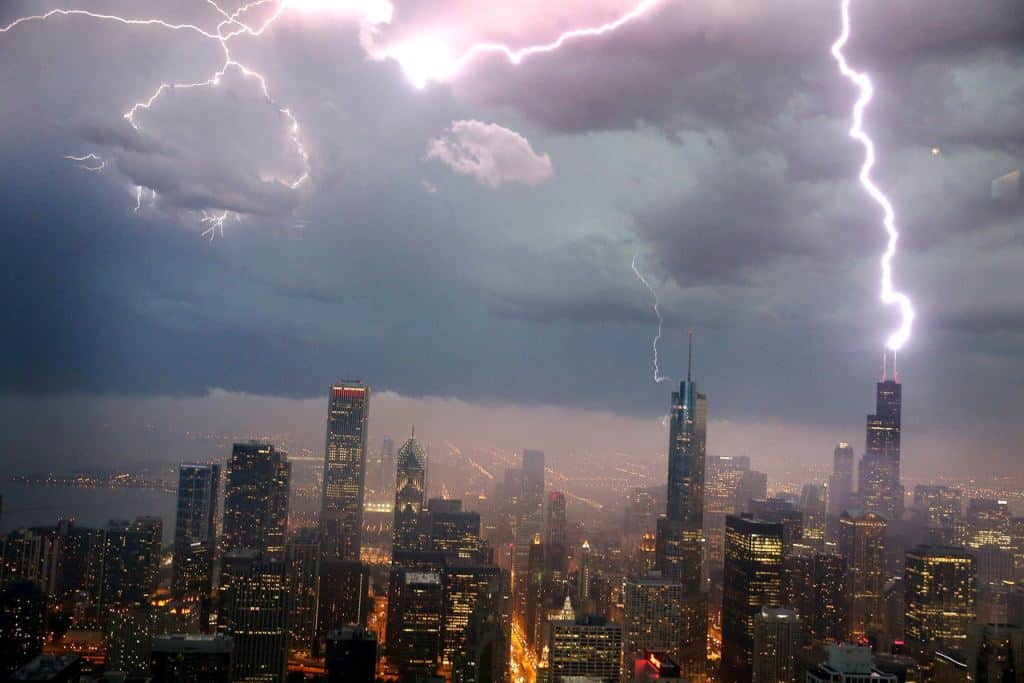
Lightning strikes the Willis Tower (formerly Sears Tower) in downtown on June 12, 2013 in Chicago, Illinois.
Photo by Scott Olson/Getty Images
Amazing Floating Cinema
The first edition of Film on the Rocks Yao Noi took place on Archipelago Cinema, designed by German-born and Beijing-based architect Ole Scheeren. Guests were taken by boat through the darkness of the sea to arrive on a glowing raft in the middle of the quiet waters of Nai Pi Lae lagoon on Kudu Island. Surrounded by a dramatic landscape of towering rocks emerging from the ocean, the audience experienced an atmospheric convergence of nature and cinematic narratives – primordial notions of light, sound and stories suspended in the darkness between sea and sky.
Courtesy of Film on the Rocks Yao Noi Foundation


Greetings to Verbalists from The Brand New Heavies
The Brand New Heavies are a British music institution whose unique mix of jazz, funk and soul has lit up the dance scene for well over three decades — and shows no sign of stopping.
READ MOREThe 50 greatest British inventions
From the steam engine and telephone to photography, television, and the jet engine, British inventions have transformed the way we travel, work, communicate, and understand the world.
Continue reading “The 50 greatest British inventions”A Welcome Home to Remember

Watch arriving passengers be given a welcome home to remember at Heathrow Terminal 5. Big thanks to all our talented singers who feature in the ad (The T-Mobile Welcome Back). READ MORE
The Most Beautiful Fountains in Europe

How Much Food Can You Buy for $5 around the World?
 With 5 Dollars you can buy 6 bananas in Australia, more than two Kg in France, almost 4 Kg in the United States and over 11 Kg in Ethiopia.
The food comparisons continue with eggs, coffee, hamburgers and beer in a genius video which shows us the amount we can buy for 5 Dollars, of the same food in different corners of the world.
_
_
_
Flower Tunnel

Wisteria (also spelled Wistaria or Wysteria) is a genus of flowering plants in the pea family, Fabaceae, that includes ten species of woody climbing vines native to the Eastern United States and to China, Korea, and Japan. Some species are popular ornamental plants, especially in China and Japan. An aquatic flowering plant with the common name wisteria or ‘water wisteria’ is in fact Hygrophila difformis, in the family Acanthaceae.
Official site: www.city.kitakyushu.lg.jp/kensetu/file_0218.html
_

The Wisteria Flower Tunnel at Kawachi Fuji Garden

The Wisteria Flower Tunnel at Kawachi Fuji Garden

The Wisteria Flower Tunnel at Kawachi Fuji Garden

The Wisteria Flower Tunnel at Kawachi Fuji Garden
Architecture of Density
German-born photographer Michael Wolf documents the extreme densities of Hong Kong. His series “Architecture of Density” rarely contain images of people, instead letting the extreme scale of the buildings remain as the focus. It’s overwhelming to view the scale and enormity of the buildings, and then realize that people live there.

Architecture of Density, Hong Kong

Architecture of Density, Hong Kong

Architecture of Density, Hong Kong