

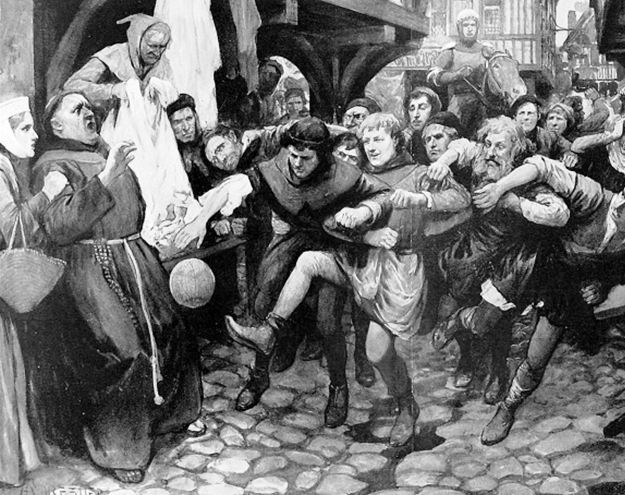
Mob football was chaotic, violent, local and almost rule-free. Yet this medieval game helped shape the football codes we know today.
Long before football had referees, neat white lines, substitutions and television replays, there was mob football.
Played in medieval towns and villages, the game could involve dozens or even hundreds of people. There was often no fixed number of players, very little agreement on the rules, and goals could be separated by streets, fields or even whole villages. The ball itself was sometimes an inflated animal bladder.
In other words, this was football before football learned to behave.
What was mob football?
Mob football is a broad modern term for several traditional forms of medieval folk football played in Britain and elsewhere in Europe. Matches were often linked to local festivals or Shrovetide celebrations, and two groups would try to move a ball toward a designated point by almost any available means.
The important thing is not to imagine a primitive version of today’s eleven-a-side game. There were no standardized pitches, no universal rules and often no clear distinction between kicking, carrying, pushing or wrestling for the ball.
Some accounts describe the games as extremely rough, with entire streets filling with players and spectators. The objective was often less about elegant passing and more about somehow getting the ball to the other side of town.
So rough that kings tried to stop it
Mob football became disruptive enough that authorities repeatedly tried to suppress it.
One of the best-known examples came in 1314, when King Edward II issued a proclamation in London against football because of the noise and disorder it caused in the city. The surviving wording complains of “great noise” created by people hustling over large balls and threatens imprisonment for continuing the game.
That did not end football. Not even close.
Similar bans and restrictions appeared again in later centuries, which tells us something quite important: people clearly liked the game too much to stop playing it.
From mob football to modern football
It would be too simple to say that mob football directly became today’s football. What happened was much messier.
Different local traditions gradually evolved, and by the 19th century schools and clubs began writing down rules. From that process came the major football codes we now recognize, including rugby football, gridiron football and association football.
Mob football is therefore better understood as one of the important ancestors of modern football rather than as an early version of one single sport.
And some of those old traditions never disappeared completely.
Traditional mass football games are still played in parts of the United Kingdom, including the famous Royal Shrovetide Football Match in Ashbourne, where large numbers of people take part and much of the town effectively becomes the playing field.
Football changed. The fascination did not.
The rules may have become clearer, the balls more predictable and the crowds considerably better organized, but the attraction of the game is still remarkably familiar: teamwork, rivalry, physical skill, local pride and the excitement of not knowing exactly what will happen next.
That is also one reason football works so well in international education. At Verbalists, we regularly see how quickly sport breaks down language barriers. Put young people from different countries on the same pitch and communication starts almost immediately, sometimes before anyone has found the right words.
Today, of course, the experience looks very different from medieval mob football. Our students can combine language learning and international summer programs with professional football training at destinations such as Chelsea FC, Liverpool FC Football Camp, Manchester City Academy, and AC Milan.
No pig’s bladder. No entire village chasing one ball. Probably for the best. 🙂
But the basic idea is still there: people come together, compete, communicate and somehow understand one another through the game.
And that may be one of football’s oldest traditions of all.
Discover more from Verbalists Education
Subscribe to get the latest posts sent to your email.